
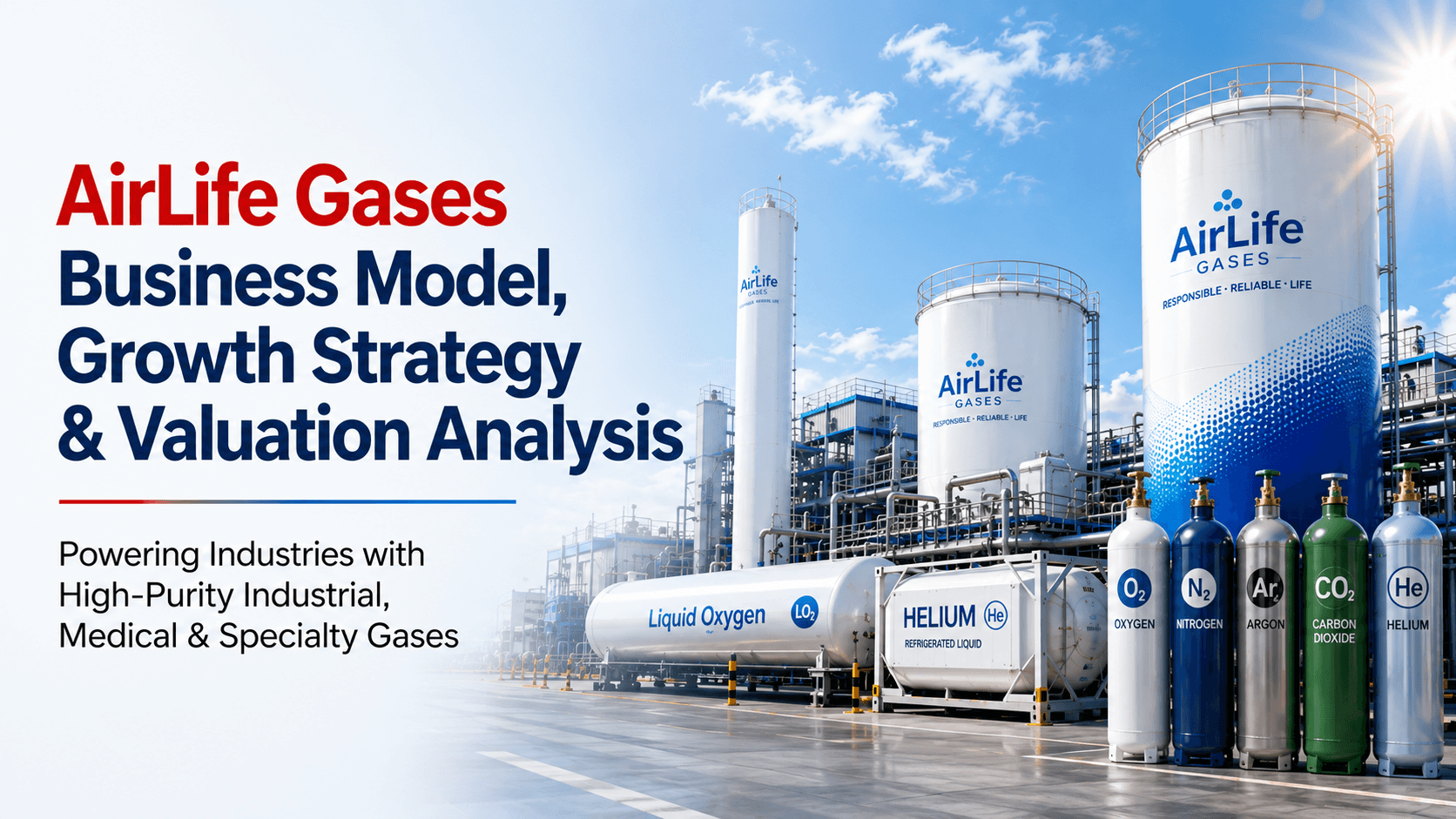
AirLife Gases Business Model, Growth Strategy & Valuation: A Complete Analysis
India's industrial gas sector is witnessing rapid transformation, driven by increasing demand from healthcare, semiconductors, aerospace, defence, electronics, and advanced manufacturing. Among the emerging companies in this space, AirLife Gases Private Limited has positioned itself as a specialized supplier of helium and other high-value industrial gases.
With a vertically integrated business strategy, global expansion plans, and increasing investments in helium infrastructure, AirLife Gases has attracted attention from investors tracking the unlisted shares market.
In this article, we explore AirLife Gases' business model, financial performance, valuation, competitive strengths, growth opportunities, and potential risks.
About AirLife Gases
AirLife Gases Private Limited is an Indian specialty gas company headquartered in Pune. The company focuses on supplying helium and other specialty gases to industries where precision, purity, and uninterrupted supply are critical.
Its customer base spans sectors including:
Healthcare
Semiconductor manufacturing
Fibre optics
Pharmaceuticals
Aerospace & Defence
Scientific research
Industrial manufacturing
Unlike many traditional distributors, AirLife has been expanding its presence across the helium value chain—from sourcing and processing to storage and distribution.
AirLife Gases Business Model
The company's strategy is built around controlling a larger portion of the helium supply chain rather than functioning solely as a distributor.
Its revenue is generated through multiple business segments.
1. Helium Distribution
AirLife supplies both liquid and gaseous helium across India and international markets using cylinders, ISO containers, tube trailers, quad packs, and cryogenic storage systems.
The company serves both bulk industrial customers and businesses requiring smaller customized supplies.
2. Long-Term Helium Supply Agreements
Instead of relying heavily on intermediaries, AirLife secures helium through long-term international sourcing agreements.
This approach helps improve supply reliability while reducing exposure to market shortages and price volatility.
3. Specialty Gas Solutions
Beyond helium, the company is expanding into high-purity specialty gases used in advanced manufacturing, semiconductor fabrication, electronics, and clean energy applications.
This diversification could help create additional long-term revenue opportunities.
4. Infrastructure & Logistics
A major competitive advantage is AirLife's investment in logistics infrastructure, including:
Cryogenic containers
ISO tanks
Helium storage systems
Transportation network
Distribution facilities
Owning critical infrastructure improves operational efficiency while reducing dependency on third-party logistics.
5. International Expansion
AirLife has expanded beyond India through investments and acquisitions in North America.
Its strategy focuses on gaining access to helium production, processing, liquefaction, and distribution assets, enabling greater control over the global supply chain.
Competitive Advantages
Several factors differentiate AirLife Gases from conventional industrial gas suppliers:
Vertically integrated helium supply chain
Strong focus on specialty gases
Presence in high-growth industries
International sourcing capabilities
Infrastructure-led business model
Expansion into North American helium assets
These initiatives are designed to improve long-term supply security while supporting future growth.
Industry Opportunity
Global demand for helium continues to increase due to its critical role in:
MRI machines
Semiconductor manufacturing
Space research
Defence equipment
Fibre optics
Scientific laboratories
Electronics manufacturing
Since helium has limited natural substitutes, demand is expected to remain resilient across multiple industries.
Recent Growth Initiatives
AirLife has taken several strategic steps to strengthen its long-term position, including:
Expansion of international helium sourcing
Investments in liquefaction infrastructure
Acquisition of upstream helium assets in Canada
Acquisition of helium processing infrastructure in the United States
Expansion of storage and logistics capabilities
These developments support the company's objective of building an integrated global helium platform.
Financial Performance
Based on publicly available information, AirLife has demonstrated growth in revenue while maintaining profitability. Investors generally evaluate the company using metrics such as:
Revenue growth
EBITDA
Profit After Tax (PAT)
Return on Equity (ROE)
Debt-to-equity ratio
Operating margins
As with any unlisted company, investors should review the latest audited financial statements before making investment decisions
AirLife Gases Valuation
The valuation of AirLife Gases is influenced by several factors:
Growth in the global helium market
Expansion into specialty gases
Strategic acquisitions
Financial performance
Future fundraising rounds
Demand for unlisted shares
Market sentiment toward industrial gas businesses
Since AirLife is an unlisted company, its share price may vary depending on transaction volumes and market demand.
Risks Investors Should Consider
Although the long-term outlook appears promising, investors should evaluate certain risks:
Dependence on global helium availability
Commodity price fluctuations
Regulatory changes
Capital-intensive expansion projects
Execution risks in international acquisitions
Competition from large global industrial gas companies
Careful due diligence is essential before investing in any unlisted company.
Future Outlook
AirLife Gases is positioning itself beyond a traditional industrial gas distributor by building capabilities across sourcing, processing, logistics, and specialty gases.
If the company successfully executes its expansion plans and benefits from rising demand in sectors such as semiconductors, healthcare, and aerospace, it could strengthen its position within the specialty gas industry.
Its long-term growth trajectory will depend on operational execution, global demand trends, and continued investment in infrastructure.
Conclusion
AirLife Gases represents an emerging player in India's specialty gas ecosystem with a strategy centered on vertical integration, infrastructure development, and global expansion.
For investors tracking AirLife Gases Unlisted Shares, the company offers exposure to a niche industry supported by long-term structural demand. However, as with all pre-IPO and unlisted investments, investment decisions should be based on detailed financial analysis, valuation assessment, and individual risk tolerance.
FAQs
1. What does AirLife Gases do?
AirLife Gases supplies helium and specialty gases to industries such as healthcare, semiconductors, aerospace, pharmaceuticals, and electronics.
2. Is AirLife Gases an unlisted company?
Yes, AirLife Gases is currently an unlisted company, and its shares are traded in the private market.
3. What is AirLife Gases' business model?
The company generates revenue through helium distribution, specialty gases, logistics infrastructure, storage solutions, and international supply chain operations.
4. What industries does AirLife Gases serve?
Its customers include healthcare, semiconductor manufacturing, defence, aerospace, fibre optics, pharmaceuticals, electronics, and research institutions.
5. What makes AirLife Gases different from other industrial gas companies?
Its focus on vertical integration, international helium sourcing, logistics infrastructure, and specialty gases differentiates it from many traditional distributors.
6. What factors influence AirLife Gases' valuation?
Revenue growth, profitability, expansion projects, strategic acquisitions, industry outlook, funding rounds, and demand for unlisted shares all play a role in its valuation.
7. Is AirLife Gases planning an IPO?
As of now, there is no officially announced IPO timeline. Investors should rely on company announcements for any future developments.