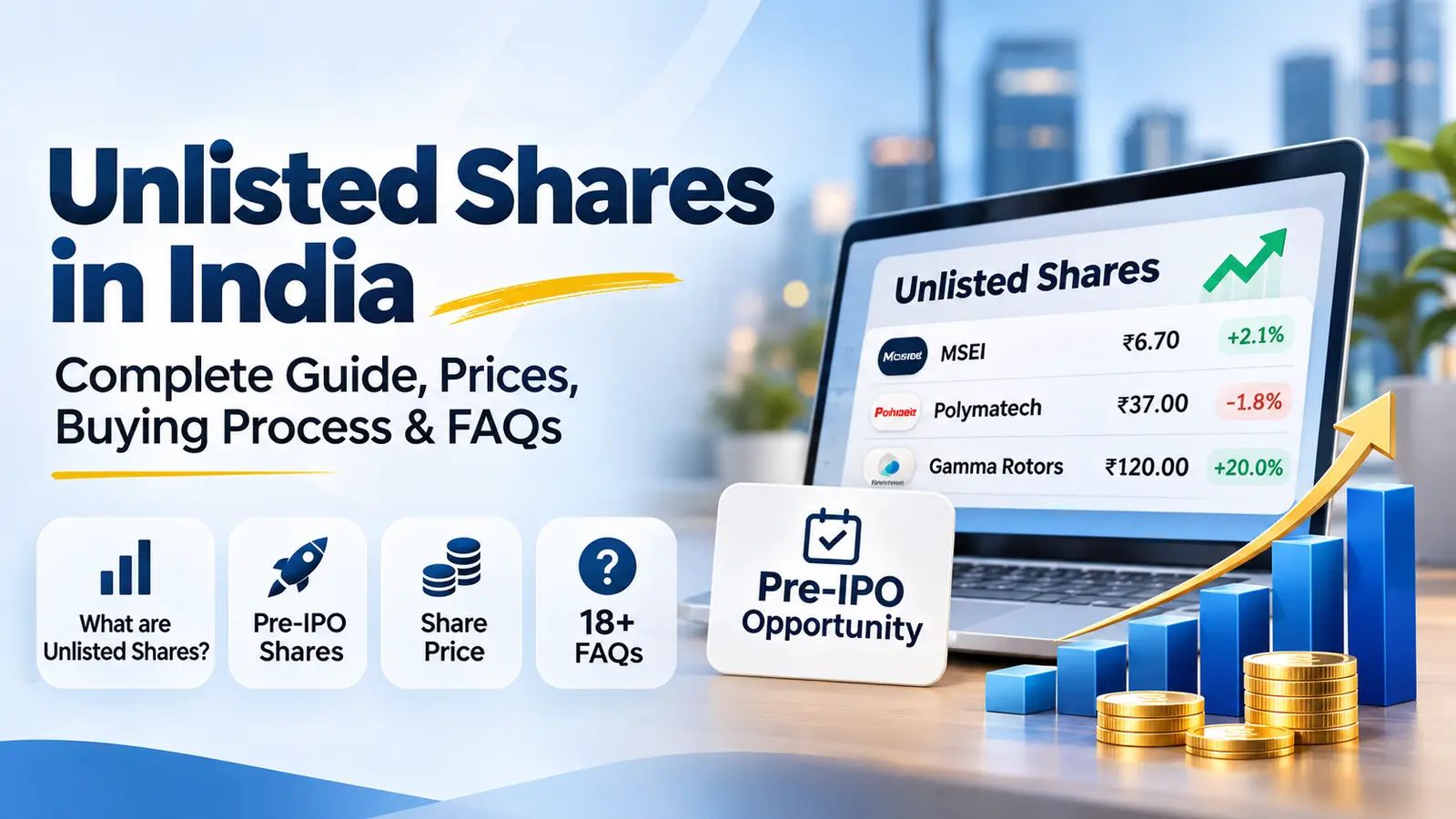
Unlisted Shares in India: Complete Guide, Prices, Buying Process and FAQs
Investing in Unlisted Shares and Pre-IPO Shares in India is becoming quite popular.
Companies in this category could be well-established private companies or growing companies, which may choose to go public (IPO) in the future. It is essential to conduct proper research, valuation and also to understand factors such as liquidity and regulation of these shares before investing.
Investors would be required to know the price of the Unlisted Share, company fundamentals, purchasing process and potential risks.
This article provides a brief overview of investing in Unlisted Shares in India. It also answers some common questions.
What Are Unlisted Shares?

Unlisted Shares refer to equity shares which are not listed by companies on major exchanges like NSE or BSE.
Companies offering unlisted equity shares can be privately owned, or may have not gone through the procedure of listing their shares. These shares can be transferred in accordance with the applicable rules, by eligible private transfers / Off Market Transactions.
Unlike listed stocks, unlisted shares cannot be traded continuously. The price of unlisted shares can be determined based on the value of the company, the demand by investors, supply by sellers in market, and private transactions.
Investors can explore different companies and compare their indicative prices through the Unlisted Shares section.
What Are Pre-IPO Shares?
Pre-IPO shares refer to shares owned by founders, employees, early investors or existing shareholders of a company prior to its IPO.
Shares may be sold through private placements from some existing shareholders.
However, it is not certain that an IPO will occur. The company may decide to change its listing plans due to changes in business, market conditions or regulatory conditions.
An investor should research the company’s financial performance, valuation, quality of management and prospects, instead of relying on expected IPOs.
Difference Between Unlisted Shares and Pre-IPO Shares
Different terms: Unlisted stocks These are stocks from companies which are not traded on recognised stock exchanges.
Pre-IPO stocks These are stocks bought prior to an intended IPO.
Not all unlisted companies will be planning an IPO, however all pre-IPO stocks will be unlisted.
By understanding the difference between these two terms you can make more realistic judgements about a company.
How Does the Unlisted Share Market Work in India?
Trading in unlisted shares: Usually, a buyer and seller will come to a private agreement. In order to complete this transaction, information must be confirmed such as the number of shares held, the identity of the seller, payment instructions and demat account details.
The price of unlisted shares will change based on market demand and supply, company performance, expected valuation, and market buyer availability.
An investor may not find a buyer for their shares quickly as would be the case with listed securities..
How Is Unlisted Share Price Determined?
The Unlisted Share Price is influenced by several financial and market-related factors.
Important considerations include:
Company's revenue and profitability.
Business growth and future prospects.
Valuation compared with similar companies.
Demand and supply among private-market participants.
Recent eligible private transactions.
Industry conditions and market sentiment.
Availability of buyers and sellers.
Indicative prices may differ between market participants and should not be treated as guaranteed transaction prices or official exchange quotations.
Investors should always check the latest available price, its update date and the actual terms of a proposed transaction.
For additional information, investors can read this Unlisted Share Price guide.
How to Buy Unlisted Shares in India
Buying Unlisted Shares generally involves identifying a company, evaluating its fundamentals, checking the indicative price and completing the applicable transfer process.
A typical transaction may involve the following steps:
Identify the company and understand its business.
Review available financial statements and company information.
Evaluate the indicative price and valuation.
Verify the seller and shareholding details.
Understand payment instructions and transaction charges.
Complete the applicable off-market transfer procedure.
Verify the share credit in the buyer's demat account.
Investors should independently verify all details before transferring money or accepting securities.
Top Unlisted Companies Investors Can Research
IInvestment opportunities may be sought in private companies in financial, technological, manufacturing, green and consumer based sectors.
Not all popular companies are a good investment opportunity.
Business model, performance, price, quality of management and level of liquidity should be considered when making investment decisions.
For additional company research, explore:
These articles can help investors discover businesses for further research. They should not be treated as guaranteed investment recommendations.
Important Risks of Investing in Unlisted and Pre-IPO Shares
Investing in Unlisted Shares and Pre-IPO Shares involves risks that may differ from those associated with listed securities.
Liquidity Risk: Finding a buyer may take time, and selling may not be possible at the desired price.
Valuation Risk: Private-market prices may not reflect a frequently updated exchange-based market value.
Information Risk: Public information may be more limited than for listed companies.
IPO Risk: A proposed IPO may be delayed, changed or cancelled.
Capital Risk: Company performance and market conditions may cause the investment value to decline.
Investors should evaluate these risks according to their financial circumstances and risk tolerance.
For a broader discussion of private-market investment considerations, read this Pre-IPO Shares guide.
Frequently Asked Questions About Unlisted Shares
1. What Is an Unlisted Share?
An unlisted share represents ownership in a company whose shares are not listed for trading on a recognised stock exchange. Such shares may be transferred through eligible private or off-market transactions, subject to applicable rules and procedures.
2. What Are the Top 5 Unlisted Shares in India?
There is no universally accepted list of the top five unlisted companies. Investors can compare businesses based on revenue, profitability, valuation, industry position, management quality and growth prospects. The suitability of a company depends on individual research and investment objectives.
3. Is It Worth Buying Unlisted Shares?
Unlisted Shares may provide exposure to businesses before they become publicly listed. However, they can involve limited liquidity, valuation uncertainty and information risks. Whether they are worth considering depends on the company's fundamentals, purchase valuation and the investor's ability to manage potential losses.
4. Which Platform Is Best for Unlisted Shares?
Investors should compare platforms based on price transparency, company information, seller verification, transaction documentation, customer support and applicable charges. They should also understand the platform's role in facilitating transactions and independently verify relevant regulatory requirements.
5. Which Is the Biggest Unlisted Company in India?
The answer depends on the measurement used, such as revenue, assets, valuation or business scale. There is no single permanent ranking of the biggest unlisted companies in India. Investors should use reliable company disclosures and dated financial information when comparing businesses.
6. Which Unlisted Share Is Good to Buy in 2026?
No particular unlisted share is suitable for every investor. Before evaluating a company in 2026, consider its financial performance, business model, valuation, industry outlook, management and liquidity. Avoid making investment decisions solely on IPO rumours or expected listing gains.
7. Do Unlisted Shares Pay Dividends?
Yes. An unlisted company may distribute dividends if permitted under applicable laws and approved through the required corporate process. However, dividend payments are not guaranteed and depend on the company's financial position and dividend decisions.
8. Which Is Better, Listed or Unlisted Company Shares?
Listed shares generally offer exchange-based price discovery, greater trading visibility and easier access to buyers and sellers. Unlisted shares may provide exposure to private companies but can involve higher liquidity and valuation risks. The choice depends on an investor's objectives and risk tolerance.
9. Do You Have to Declare Unlisted Shares in ITR?
Investors should understand the applicable income-tax disclosure requirements when holding or selling unlisted shares. Reporting obligations may depend on residential status, the nature of the investment, income earned and applicable tax rules. Consult a qualified tax professional for advice based on your circumstances.
10. What Happens to Unlisted Shares After IPO?
If a company successfully completes its IPO and its shares become listed, existing shareholders may continue holding their shares, subject to applicable listing conditions, lock-in requirements and regulatory provisions. The ability to sell may depend on the relevant restrictions and eligibility conditions.
11. What Is the Current Price of Unlisted Shares?
There is no single price for all unlisted companies. Each company's Unlisted Share Price may change according to demand, supply, valuation and business performance. Investors should check the latest indicative price, its update date and the actual transaction conditions.
12. What Are the Best Unlisted Shares to Buy in India?
The best Unlisted Shares cannot be identified through popularity alone. Investors should compare financial performance, valuation, industry position, management quality, liquidity and available disclosures before evaluating any company.
13. What Is the Cheapest Share Trading Platform?
Platform costs depend on the investment product and services provided. Investors should compare brokerage, transaction charges, account-related fees and other applicable costs. A platform offering listed stock trading may not necessarily facilitate private unlisted share transactions.
14. Can I Buy Unlisted Shares in Zerodha?
Zerodha primarily provides access to exchange-listed securities and other supported investment products. Purchasing privately transferred unlisted shares is different from placing an ordinary stock exchange order. Investors should confirm the latest supported services directly with the platform.
15. Who Is the Best Unlisted Share Broker in India?
There is no single intermediary that is best for every investor. Compare price transparency, seller verification, transaction documentation, service quality, company information and applicable charges. Independently verify all transaction details before proceeding.
16. Is It Profitable to Buy Unlisted Shares?
Unlisted Shares may increase or decrease in value depending on company performance, valuation, market conditions and buyer availability. There is no guaranteed return, and investors should consider the possibility of partial or complete capital loss.
17. What Is the Lock-in Period for Unlisted Shares?
There is no single lock-in period applicable to every unlisted share. Restrictions may depend on the company's status, shareholder category, applicable securities regulations and IPO-related requirements. Investors should verify the specific conditions before purchasing.
18. How Can Investors Check Unlisted Share Prices?
Compare price indications. Check what date it was last updated. Compare the information on the transactions. Understand that the price shown may vary from real transaction prices.
Evaluating unlisted companies
Do not simply make judgements based on the share price or popularity of a company. Following a structured evaluation of a company will allow you to better understand the business and potential risks.
Business Model: Understand how the company generates revenue, who its customers are and what products or services it provides.
Financial Performance: Review revenue, profitability, debt levels, cash flow and available financial statements.
Management: Consider the experience and background of the leadership team using verifiable information.
Valuation: Compare the company's valuation with its financial performance, business prospects and relevant industry benchmarks.
Liquidity: Understand the availability of buyers and the potential time required to sell the shares.
Documentation: Verify shareholding information, seller identity and transfer requirements.
Reliable information can be accessed from official sources. For example, the SEBI investor site provides investment tips on markets and what risks may be present.
Dhankirti Wealth
Information and indicative pricing of companies within private markets.
Within this section, information is provided on different unlisted companies and indicative pricing of these shares. Investors can look at the Unlisted Shares available, compare information between companies and make independent investment decisions.
Visit Dhankirti Wealth to learn more about the platform and its services.
Whether researching Unlisted Shares, evaluating Pre-IPO Shares or comparing an Unlisted Share Price, investors should conduct independent due diligence and understand the risks before making a decision.
Disclaimer
This article contains general information and is not advice. Before making any investments you should seek independent professional advice. All unlisted investments include risk factors such as illiquidity, price uncertainty and potential loss of principal. The prices shown are indicative and may differ from the actual price you pay. Where relevant you should consult a suitable financial and taxation professional, and ensure that you have checked all relevant information before investing.