
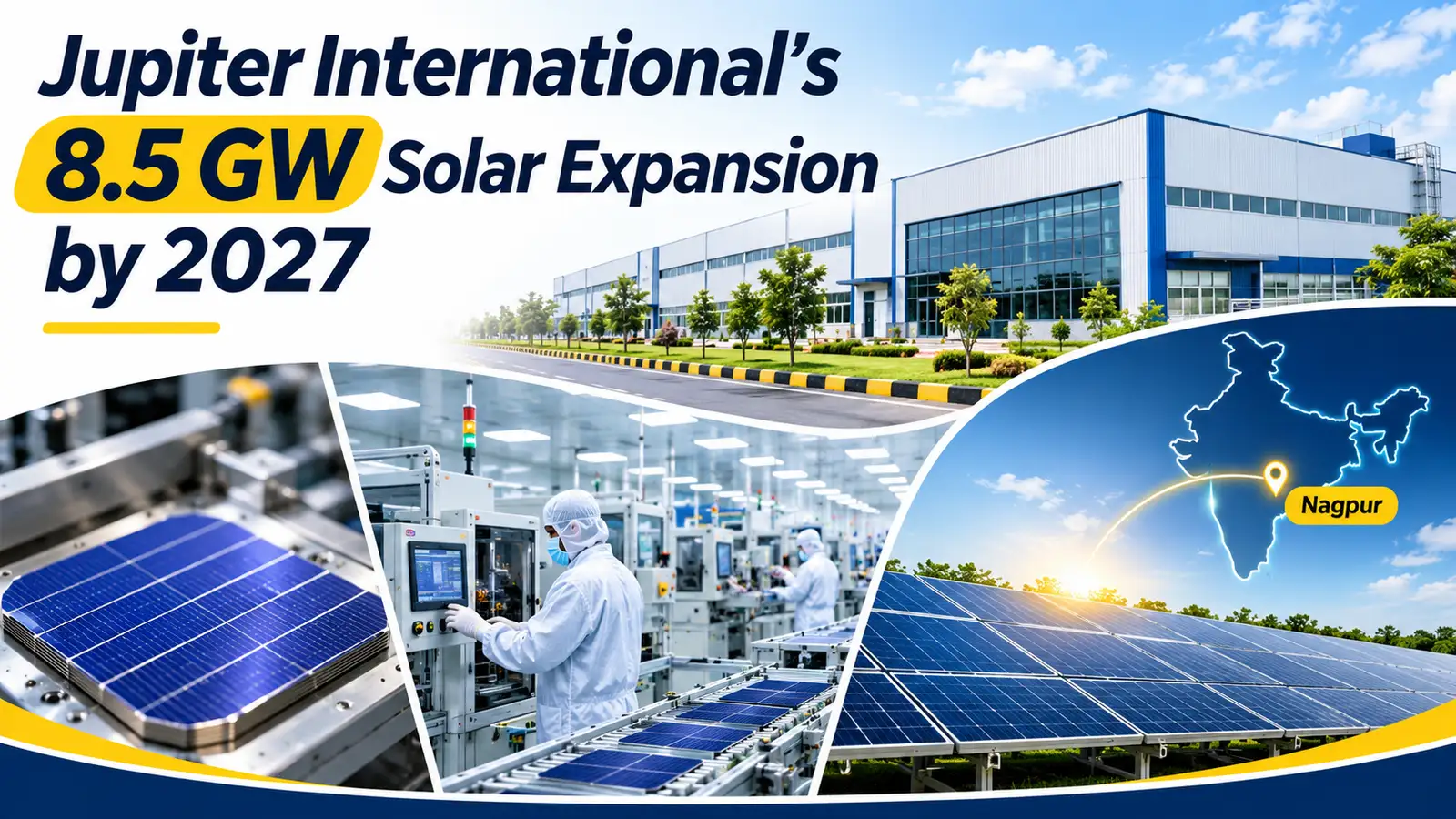
India's solar energy sector is growing rapidly, and domestic manufacturers are gearing up to capture the opportunities emerging in renewable energy. Among the companies expanding their presence in this space is Jupiter International, which has set an ambitious target of reaching 8.5 GW of solar cell manufacturing capacity by April 2027.
According to a report published by Saur Energy International on November 13, 2026, the company is developing a new 3 GW TOPCon solar cell manufacturing facility in Nagpur, Maharashtra. Alongside this, it is also exploring backward integration through a proposed 1.5 GW ingot and wafer manufacturing project.
With investments in advanced technology and manufacturing infrastructure, Jupiter International is preparing for its next phase of growth.
Let's look at what is driving this expansion and why it matters for India's solar manufacturing industry.
Jupiter International's 8.5 GW Expansion Plan
Jupiter International has come a long way since entering the solar manufacturing business in 2009 with an initial annual capacity of just 45 MW.
Today, its existing solar cell manufacturing capacity stands at approximately 4.5 GW.
Technology | Existing Capacity |
|---|---|
Mono PERC | 3.25 GW |
TOPCon | 1.3 GW |
Total | 4.5 GW |
To expand its manufacturing capabilities, the company is setting up a new 3 GW TOP Con facility in Nagpur.
Commercial production is expected to begin between February and March 2027, with full-scale production targeted by the end of the following quarter.
The company's broader goal is to reach 8.5 GW of solar cell manufacturing capacity by April 2027.
This expansion highlights its focus on increasing production while preparing for the industry's shift towards advanced solar technologies.
Why Is Jupiter International Investing in TOP Con Technology?
The solar manufacturing industry is gradually moving towards more efficient technologies, and TOP Con is gaining significant attention.
TOP Con (Tunnel Oxide Passivated Contact) is an advanced solar cell technology designed to improve energy conversion efficiency and reduce electrical losses compared with conventional PERC technology.
Jupiter International expects Mono PERC and TOP Con technologies to coexist for some time, although its management anticipates a gradual shift towards TOP Con by the end of 2027 or 2028.
The company is also focusing on larger wafer formats, particularly G12R, which can support higher power output and improved manufacturing economics.
Its investment in TOP Con technology reflects the growing importance of innovation and efficiency in India's competitive solar manufacturing market.
Beyond Solar Cells: The 1.5 GW Ingot and Wafer Project
Another important development is Jupiter International's proposed 1.5 GW ingot and wafer manufacturing project.
Why is this important?
Solar manufacturing involves several stages, from processing silicon into ingots and wafers to converting them into solar cells and eventually solar modules.
By entering ingot and wafer manufacturing, Jupiter International is looking to strengthen its presence in the earlier stages of the production process.
This strategy is known as backward integration, where a company develops capabilities in its supply chain instead of depending entirely on external suppliers.
The company plans to begin with an initial 1.5 GW capacity, evaluate operational performance and establish proof of concept before considering further expansion.
This could become an important step towards building a more integrated solar manufacturing business.
What Makes India's Solar Manufacturing Sector Interesting?
India's renewable energy ambitions are creating opportunities across the solar manufacturing value chain.
Increasing solar power adoption, domestic manufacturing initiatives and demand for advanced technologies are encouraging companies to expand their operations.
For manufacturers such as Jupiter International, this presents opportunities across:
Solar cell and module manufacturing.
Ingot and wafer production.
Advanced TOP Con technology.
Domestic solar supply chains.
Renewable energy infrastructure.
However, the industry is also becoming increasingly competitive. Technology upgrades, production costs, operational efficiency and actual market demand will play important roles in determining long-term business performance.
What Should Investors Watch in Jupiter International?
Jupiter International's expansion plans bring several developments worth tracking:
1. New Manufacturing Capacity: Progress and commissioning of the 3 GW Nagpur TOP Con facility will be important.
2. Technology Adoption: The transition towards TOP Con and larger wafer formats could influence long-term competitiveness.
3. Backward Integration: The proposed 1.5 GW ingot and wafer project could strengthen the company's manufacturing value chain.
4. Operational Efficiency: Managing production costs, quality and manufacturing efficiency will be essential as capacity increases.
5. Industry Demand: Growing demand for solar components and competition among domestic manufacturers will influence future business prospects.
While expansion creates opportunities, higher manufacturing capacity does not automatically guarantee higher profitability. Successful execution and market conditions will remain crucial.
To know the latest price, fundamentals, and financial performance of Jupiter International Limited Unlisted share, visit our page.
Final Takeaway
From starting with just 45 MW of manufacturing capacity in 2009 to targeting 8.5 GW by April 2027, Jupiter International's journey reflects the changing landscape of India's solar manufacturing industry.
Its upcoming 3 GW TOP Con facility, proposed 1.5 GW ingot and wafer project, and focus on advanced technology highlight an ambitious expansion strategy.
The next phase will depend on how effectively the company executes these plans, scales production and manages competition.
For investors following India's renewable energy sector and emerging private market companies, Jupiter International is a name worth keeping on their radar.
Stay Updated with Dhankirti!
Explore the latest developments in India's unlisted shares, pre-IPO companies and private market opportunities with Dhankirti.
Website: https://dhankirti.co.in/
Disclaimer: This article is for informational and educational purposes only and should not be considered investment advice or a recommendation to buy or sell securities. Investments in unlisted shares carry risks, including liquidity and valuation risks. Conduct independent research before making investment decisions.
Frequently Asked Questions (FAQs)
1. What is Jupiter International's solar capacity target for 2027?
The company is targeting 8.5 GW of solar cell manufacturing capacity by April 2027.
2. Where is Jupiter International setting up its new 3 GW facility?
The new TOPCon solar cell manufacturing facility is being developed in Nagpur, Maharashtra.
3. What is TOPCon solar technology?
TOPCon is an advanced solar cell technology designed to improve energy conversion efficiency and reduce electrical losses.
4. What is Jupiter International's 1.5 GW ingot and wafer project?
It is a proposed manufacturing project aimed at strengthening the company's backward integration and supply chain capabilities.
5. Why is Jupiter International's expansion important?
The expansion highlights growing investment in domestic solar manufacturing, advanced technology and India's renewable energy ecosystem.