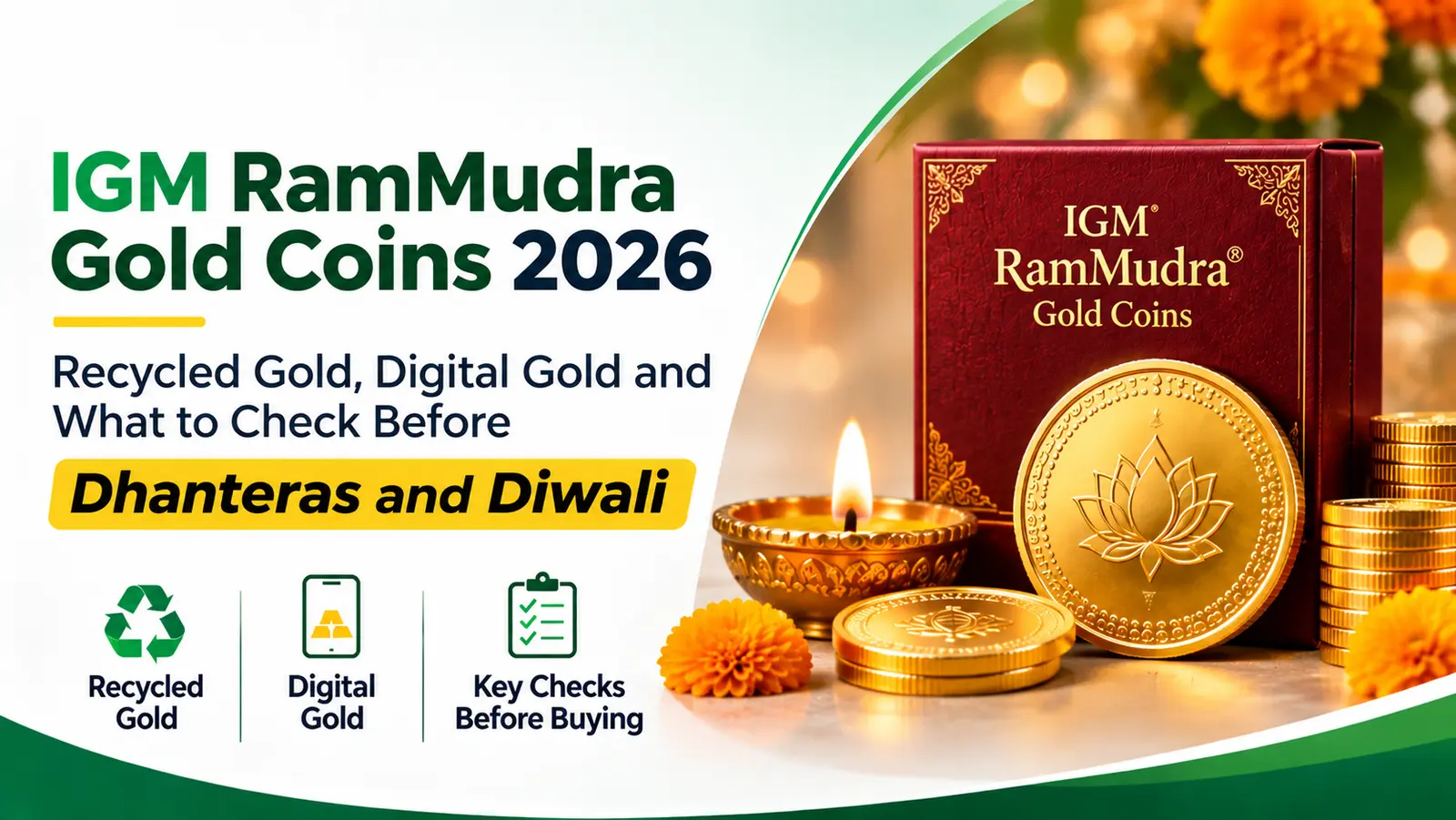
Short answer: RamMudra (Kuberdev ka Sona/ Divine Blessed Gold), a product from India Gold Metaverse (IGM) was launched ahead of Dhanteras and Diwali 2026. This product includes both physical gold coins of 999.9 purity plus a digital gold variant on the blockchain. The following information comes from an announcement made by IGM. Digital gold products are unregulated by SEBI so it is important to research the product and seller.
This guide will tell you what the product is, what claims are made by the company, what the difference is between gold coins, digital gold and SEBI regulated gold. At the end there is a checklist to help you ensure you're purchasing gold bullion correctly this festive season. Dhankirti Wealth does not sell or recommend any RamMudra products. This article is purely for educational purposes.
IGM RamMudra at a glance
Item | Detail (as stated by IGM) |
|---|---|
Company | IGM (India Gold Metaverse) |
Product name | RamMudra, “Kuberdev ka Sona” or “Devya Sona” (Divine Blessed Gold) |
Launch timing | Ahead of Dhanteras and Diwali 2026 |
Physical product | Limited-edition gold coins, 999.9 purity, five designs |
Denominations | 1 g, 2 g, 5 g, 10 g, 20 g, 50 g and 100 g |
Digital product | Blockchain-based digital gold with “Proof of Reserves” |
Gold source | 100% recycled domestic gold; “India Good Delivery” bullion; zero-import policy |
Digital minimum | ₹10 via the RamMudra app or website |
What is RamMudra, and how is it positioned?
IGM’s concept behind offering this product (RamMudra) stems from the traditional beliefs attached to Dhanteras and Diwali. As Lakshmi is the GODDESS OF WEALTH and Lord Kuber is believed to be the guardian of wealth it is not complete to buy Gold for the festival. The modern technology of using Gold in the form of Coins and Digital Gold are combined with such traditional ideals to create this product. This is backed by the two concepts ‘Gold is Technology’ and ‘Gold is Emotions’.
The name comes from a legend attached to Tirupati. As per the legend Lord Kuber had taken out 14 lakh RamMudra Gold coins to lend during Lord Balaji and goddess Padmavatis wedding, which today would be worth around ₹21,000 crore. IGM have also pledged a portion of the profits from RamMudra in the form of Gold to Tirupati Balaji Trust. Please ask for supporting documentation if you wish to use this information.
RamMudra gold coins: designs, 999.9 purity and sizes
IGM says the five designs on the front of the physical coins are:
Design | Theme |
|---|---|
Kuber | Lord Kuber, the guardian of wealth |
Padmavati-Balaji-Lakshmi | The Tirupati-linked motif |
Lakshmi | Goddess Lakshmi |
Saraswati-Lakshmi-Ganesh | The three deities together |
Dhanvantari | The divine physician honoured on Dhanteras |
The coins are described as 999.9 purity fine gold, which means 99.99% pure. They come in seven sizes from 1 gram to 100 grams. IGM suggests jewellers can pair a Kuber or Dhanvantari coin with a traditional Lakshmi purchase.
What does “recycled gold” mean, and what should you verify?
Recycled gold simply means that the gold that you are using has been refined from existing sources such as old jewellery or gold scrap rather than new gold being mined or imported. The gold itself is chemically identical but will need to be pure, genuine and have the correct paperwork to give buyers peace of mind.
IGM makes several supply-chain claims:
The coins use 100% recycled domestic gold, and IGM says RamMudra is the only gold coin in India made this way.
IGM follows a zero-import policy and uses only domestic “India Good Delivery” bullion, under the line “Bharat ka sona, Bharat ke liye”.
It links this approach to the government’s Atmanirbhar Bharat vision.
These are company claims. Before relying on them, ask the seller for the purity certificate, the invoice and any documentation of the recycled-gold sourcing.
RamMudra digital gold and blockchain: how it is described
IGM describes RamMudra digital gold as a blockchain-based “Gold-Backed Digital Token” with Proof of Reserves. According to the company:
Every digital unit is backed 1:1 by physical gold.
Sequel Logistics is the custodian and Vistra Global Solutions is the administrator.
The buyer, custodian and administrator can access verification nodes on the blockchain, which IGM says lets holdings be checked independently in real time.
Buyers can start from ₹10 through the RamMudra app or website, and both routes can also be used to buy physical coins.
First-time online buyers of a physical RamMudra coin receive ₹10 of digital gold free.
A blockchain record can show that a token exists. It cannot, by itself, prove that the underlying gold is physically held, insured and legally available to you. That depends on the custody arrangement and the legal terms of the product.
Is digital gold regulated in India?
This is the most important point for anyone considering digital gold. On 8 November 2025, SEBI issued Press Release No. 70/2025 cautioning the public about “Digital Gold” and “E-Gold” products offered by online platforms. SEBI said:
Such products are neither notified as securities nor regulated as commodity derivatives, and operate outside SEBI’s purview.
They may expose investors to counterparty and operational risks.
Investor protection mechanisms available in SEBI-regulated markets do not apply to them.
Investors who want gold exposure should consider SEBI-regulated options: Gold ETFs, exchange-traded commodity derivatives and Electronic Gold Receipts (EGRs), accessed through SEBI-registered intermediaries.
The Indian Jeweller report does not state whether RamMudra falls under any regulator. If you are considering any digital gold product, including this one, ask the provider directly about its regulatory status, who holds the gold, how you can redeem it and what happens if the provider fails.
Dhanteras and Diwali 2026: dates
Day | Date |
|---|---|
Dhanteras | Friday, 6 November 2026 |
Naraka Chaturdashi (Choti Diwali) | Saturday, 7 November 2026 |
Diwali (Lakshmi Puja) | Sunday, 8 November 2026 |
Govardhan Puja | Monday, 9 November 2026 |
Bhai Dooj | Tuesday, 10 November 2026 |
Puja and buying muhurat timings vary by city, so confirm them with your local panchang.
Gold coins vs digital gold vs SEBI-regulated gold: how they differ
Feature | Physical gold coin | Digital gold | Gold ETF / EGR |
|---|---|---|---|
SEBI regulation | Not a SEBI product | Outside SEBI’s purview, per SEBI | SEBI-regulated |
Holding | You hold the coin | Provider holds gold, you hold a claim | Held in demat form |
Purity check | Invoice, certificate and verification | Depends on provider’s custody and audits | Exchange-traded, standardised |
Storage | Your responsibility (home or locker) | Provider’s custody | No physical storage |
Main risks | Theft, purity doubts, resale discount | Counterparty and operational risk | Market price risk |
Festive or ritual use | Suited to puja | Not physical | Not physical |
No option is best for everyone. Physical coins suit ritual use, while SEBI-regulated products offer more investor protection if your goal is a financial holding.
Costs and tax on gold coins
GST: gold coins attract 3% GST at purchase. Making or minting charges may be extra, so ask for an itemised invoice.
Capital gains: gold, including coins and digital gold, is treated as a long-term asset after 24 months. Long-term gains are taxed at 12.5% without indexation. Gains within 24 months are taxed at your slab rate.
Gold ETFs are listed securities and qualify for long-term treatment after 12 months.
Keep your invoice. It proves your purchase date and cost.
Rules can change, so verify them on the Income Tax Department website or with a chartered accountant.
Checklist: before you buy a gold coin or digital gold this festive season
Check the day’s gold rate from more than one source, and compare the seller’s price with it.
Ask for an itemised invoice showing weight, purity, gold value, making charges and GST.
Confirm purity and authenticity. Look for the stated purity, sealed packaging and a certificate. For hallmarked items, use the BIS Care app and verification tools where applicable.
Ask about buy-back and resale. Many sellers pay less than they charge, so understand the difference.
For digital gold, ask who holds the gold, whether it is insured, how redemption works and whether the provider is regulated.
Do not rely only on promotional claims. Phrases like “only”, “first” or “one of a kind” are marketing statements.
Pay safely and avoid large cash payments.
Keep your documents for tax purposes.
Diversifying beyond gold
Festive gold buying is often a ritual rather than an investment decision. If you are also exploring other long-term options, explore unlisted shares in India on Dhankirti Wealth. Unlisted shares carry liquidity, valuation and IPO risks and are not suitable for everyone, so read the details and risks carefully before investing.
Frequently asked questions
1. What is RamMudra?
RamMudra is a range of gold coins and digital gold launched by IGM (India Gold Metaverse) ahead of Dhanteras and Diwali 2026.
2. Who launched RamMudra gold coins?
IGM, short for India Gold Metaverse, according to the Indian Jeweller report dated 3 November 2026.
3. What does “Devya Sona” or “Divine Blessed Gold” mean?
It is IGM’s branding for RamMudra. The company says a portion of profits is pledged to the Tirupati Balaji Trust, which it uses to describe the coins as blessed.
4. What is the purity of RamMudra gold coins?
IGM states 999.9 purity, which means 99.99% pure fine gold.
5. What sizes do RamMudra coins come in?
IGM lists seven sizes: 1 g, 2 g, 5 g, 10 g, 20 g, 50 g and 100 g.
6. How many designs do the coins have?
Five: Kuber, Padmavati-Balaji-Lakshmi, Lakshmi, Saraswati-Lakshmi-Ganesh and Dhanvantari.
7. What is recycled gold?
Gold refined from existing sources such as old jewellery or scrap instead of newly mined or imported metal. IGM says RamMudra uses 100% recycled domestic gold.
8. Is RamMudra really the only coin made from recycled gold?
That is IGM’s claim. It has not been independently verified in the report, so ask for documentation.
9. What is RamMudra digital gold?
A blockchain-based “Gold-Backed Digital Token” that IGM says is backed 1:1 by physical gold held by a custodian.
10. What is the minimum purchase for RamMudra digital gold?
₹10, via the app or website, according to IGM.
11. What does Proof of Reserves mean?
It is a method for showing that a provider holds the assets backing its tokens. The strength of the proof depends on who verifies it and how often.
12. Is digital gold regulated by SEBI?
No. SEBI said in November 2025 that such products are neither securities nor regulated commodity derivatives, and investor protection mechanisms do not apply.
13. Is RamMudra digital gold safe?
This guide cannot assess that. Check the provider’s regulatory status, custody arrangement, redemption terms and what happens if it fails.
14. When is Dhanteras 2026?
Friday, 6 November 2026. Puja timings vary by city, so check your local panchang.
15. When is Diwali 2026?
Sunday, 8 November 2026, which is the main Lakshmi Puja day.
16. Should I buy a gold coin or digital gold?
It depends on your purpose. Coins suit ritual use, while SEBI-regulated gold products offer more investor protection for financial holdings.
17. Is GST charged on gold coins?
Yes, 3% on the gold value, and making charges may be extra.
18. How is profit on gold coins taxed?
Gains on holdings of 24 months or less are taxed at your slab rate. Beyond 24 months, they are taxed at 12.5% without indexation.
19. How do I check the purity of a gold coin?
Check the stated purity on the coin and packaging, the invoice and certificate, and use BIS verification tools where the item is hallmarked.
20. What are SEBI-regulated ways to invest in gold?
Gold ETFs, exchange-traded commodity derivatives and Electronic Gold Receipts, through SEBI-registered intermediaries.
Conclusion
IGM’s new RamMudra collection is a standout collection during Dhanteras and Diwali 2026 that offers a fun merge of traditional gold and recycling and blockchain. However, there is not much information on this other than what was mentioned in their announcement. When buying physical gold coins always check if they are pure and what the documentation will be like plus what resale conditions can be offered. If you are purchasing digital gold it should be noted that SEBI have warned that digital gold is not regulated by them. Always compare different sellers and make sure you have the invoice. Only purchase what you know!. For other long-term options, visit Dhankirti Wealth.
Disclaimer: The information contained within this article is for educational purposes and should not be considered investment, legal or tax advice. The product details have been sourced from information provided by the company and contained within a trade publication and have not been independently verified. Gold prices fluctuate. Digital gold and unlisted stock can be a high risk product. Rules and rates can change so always check with an official source. Dhankirti Wealth do not sell, recommend or guarantee any products mentioned.