
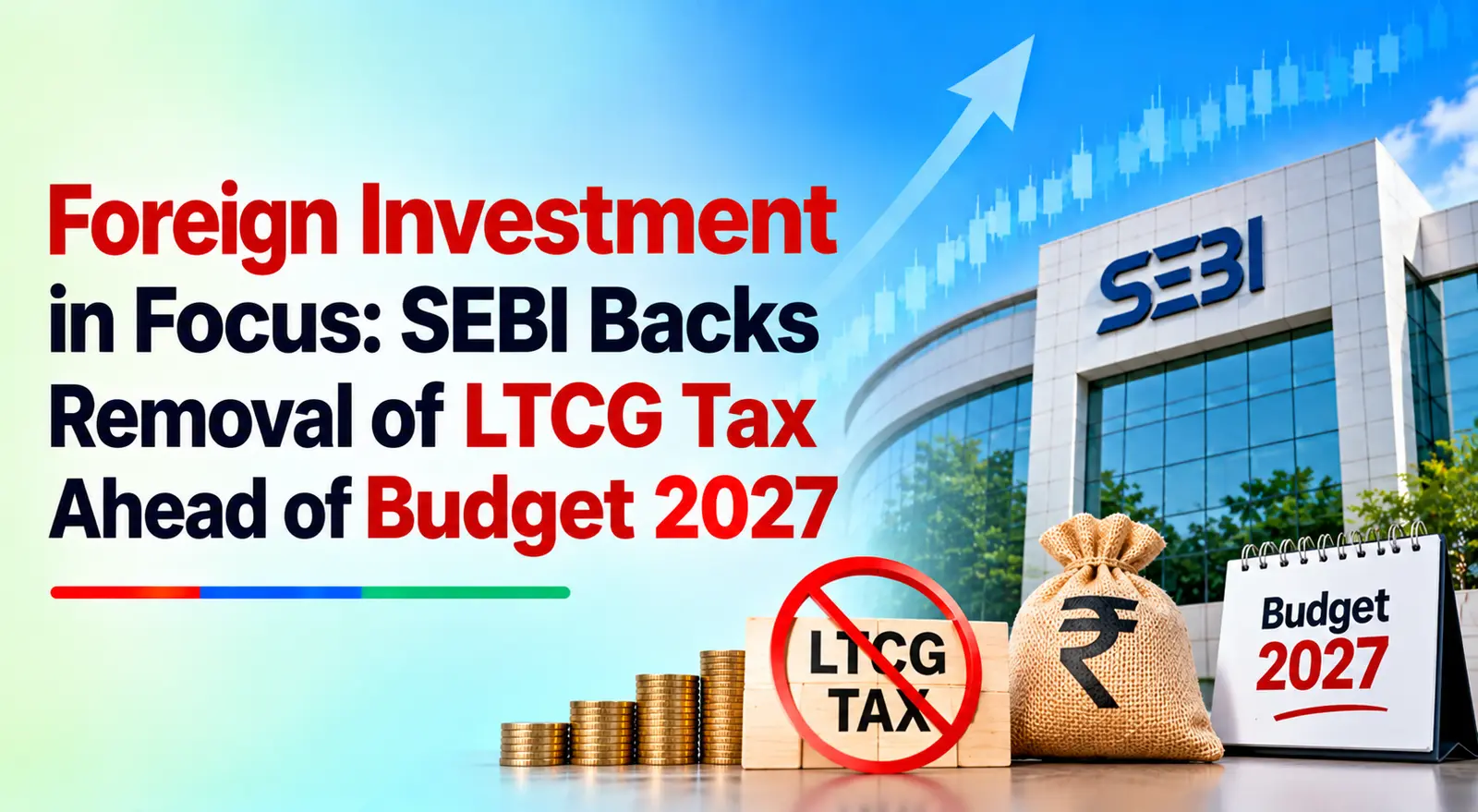
SEBI Backs Removal of LTCG Tax for Foreign Investors
Foreign money has long shaped the direction of Indian equities. With overseas investors pulling out heavily this year, taxation is now at the center of the debate. SEBI has backed the removal of long-term capital gains (LTCG) tax for foreign investors, and the recommendations, which come months before the February Budget, are not binding, so the final call rests with the government.
For FPIs, domestic investors, and anyone tracking Budget 2027, this is a development worth understanding. For more market and investment updates, you can follow Dhan Kirti.
What Has SEBI Recommended?
SEBI’s view is that India’s tax and cost structure makes it less attractive to global capital. The regulator has said that transaction costs for investing in Indian equities are among the highest across jurisdictions. Scrapping LTCG tax for foreign investors is seen as one way to lower that burden and make Indian markets more competitive.
The proposal is a recommendation, not a law. Any change would have to be announced by the government, most likely in the Union Budget.
Why Is This Happening Now? The FPI Outflow Problem
The timing is no coincidence. The government is reviewing LTCG tax and securities transaction tax (STT) ahead of Budget 2027 amid ₹3.07 lakh crore in FPI outflows from Indian equities. Indian stocks have also lagged global peers, and the rupee has weakened against the dollar.
Industry watchers see Budget 2027 as a chance to review equity taxation, as foreign flows face pressure from high global interest rates, competing markets, and currency volatility.
What Is the Current LTCG Tax on Equities?
The Union Budget 2026 kept the LTCG tax on listed equities and equity mutual funds at 12.5%. Market participants have asked for a rollback or a reduced rate. One of the key demands is to reduce the 12.5% rate or restore the earlier 10%.
What Is the Government Saying?
The government has kept its options open without committing to anything:
Finance Minister Nirmala Sitharaman said on October 13 that the government was open to views on LTCG tax and securities transaction tax (STT), but made no commitment to changes in Budget 2027.
The government has sought feedback from investors, market participants, and tax experts on the LTCG rate and STT.
The government is reportedly reviewing tax structures in South Korea, Taiwan, and Brazil, with SEBI presenting its recommendations to the Finance Ministry.
Dollar-based calculation of gains for foreign investors is also reportedly under consideration.
Who Else Is Pushing for Change?
SEBI is not alone. Industry body PHDCCI has sought abolition of LTCG tax on listed equities and a lower short-term capital gains rate. SBI Research has also recommended removing equity LTCG tax, linked to a longer holding period of 2–3 years.
The Challenges: Why It’s Not a Done Deal
There are real trade-offs for policymakers:
Fiscal cost. Any relief would need to balance the benefits of attracting foreign capital against the fiscal cost.
Tax parity. Exempting foreign investors alone could raise fairness questions for domestic investors. The government is weighing investor concerns against tax parity and round-tripping risks.
Speculation risk. Policymakers must also consider the risk of encouraging excessive speculative activity.
For context, in July 2026 the government told Parliament that it had not removed LTCG tax for foreign investors in general. A narrower exemption does exist: the Income-Tax (Amendment) Ordinance, 2026 abolished LTCG tax on FII investments in government securities.
What Could This Mean for Investors?
Foreign investors (FPIs): A lower tax burden could improve post-tax returns and help reverse outflows.
Domestic retail investors: There is no change yet. Current LTCG rules still apply, and any relief for domestic investors is only under discussion. Explore more investing and tax insights on Dhan Kirti to plan your next move.
Markets: Expectations of a favorable Budget could support sentiment, but nothing is confirmed until the announcement.
What to Watch Before Budget 2027
Whether consultations lead to a concrete proposal
Any change in the LTCG rate, holding period, or STT
Whether relief is limited to foreign investors or extended to all
The February Budget speech
Conclusion
SEBI’s backing adds weight to the case for easing capital gains tax on foreign investors, but it is still a recommendation. With heavy FPI outflows and a weaker rupee, the government has reason to consider it, though fiscal and fairness concerns remain. Investors should wait for the Budget before making decisions based on this proposal.
Disclaimer: This article is for informational purposes only and is not financial or tax advice. Please consult a qualified professional before making investment decisions.
Frequently Asked Questions (FAQs)
1. What has SEBI recommended about LTCG tax?
SEBI has backed removing long-term capital gains tax for foreign investors to make Indian equities more attractive and lower transaction costs.
2. Is the LTCG tax on foreign investors removed already?
No. The recommendation is not binding, and the government has not announced any abolition. The final decision rests with the government, likely in Budget 2027.
3. What is the current LTCG tax rate on equities in India?
The LTCG tax on listed equities and equity mutual funds is currently 12.5%.
4. Why are foreign investors pulling money out of Indian markets?
Reasons cited include underperformance versus global peers, a weaker rupee, high global interest rates, competition from other markets, and tax and transaction costs.
5. Will domestic retail investors benefit?
Not at present. The SEBI recommendation focuses on foreign investors, though other bodies like PHDCCI are seeking relief for listed equities more broadly. Existing rules apply until the government announces changes.
6. When will the government decide?
Any decision is expected in the Union Budget 2027-28, due in February.
7. What is STT, and is it part of the discussion?
Securities Transaction Tax is a levy on trading in listed securities. The government is also reviewing STT alongside LTCG tax, but no reduction has been announced.